
A Reintroduction to the To-Do List (for Type B People)
I am a Type B person at heart — which is often surprising to people who know me. I’ve heard the jokes about how I’m “actually very Type A,” and every time I hear that, I laugh. If you could see inside my brain, you’d know how untrue that is.
I want to be more Type A sometimes. I love the idea of planning everything down to the minute: waking up at 5:30am, perfectly stacked habits, color-coded calendars, and a level of productivity that looks effortless and elite.
But in practice? That version of planning has never worked for me.
Instead, it traps me in a cycle of over-planning and under-executing. The moment I deviate from the plan — sleeping until 7 instead of 5:30, getting distracted, deciding to do something spontaneous — the entire day feels like a failure before it even really starts.
After years of self-help books, productivity frameworks, and trying to force myself into systems that clearly weren’t built for me, I realized something important:
I didn’t need more structure. I needed the right kind of structure.
Not structure that controls every minute — but structure that gives direction without suffocating flexibility.
That realization completely changed how I use to-do lists.
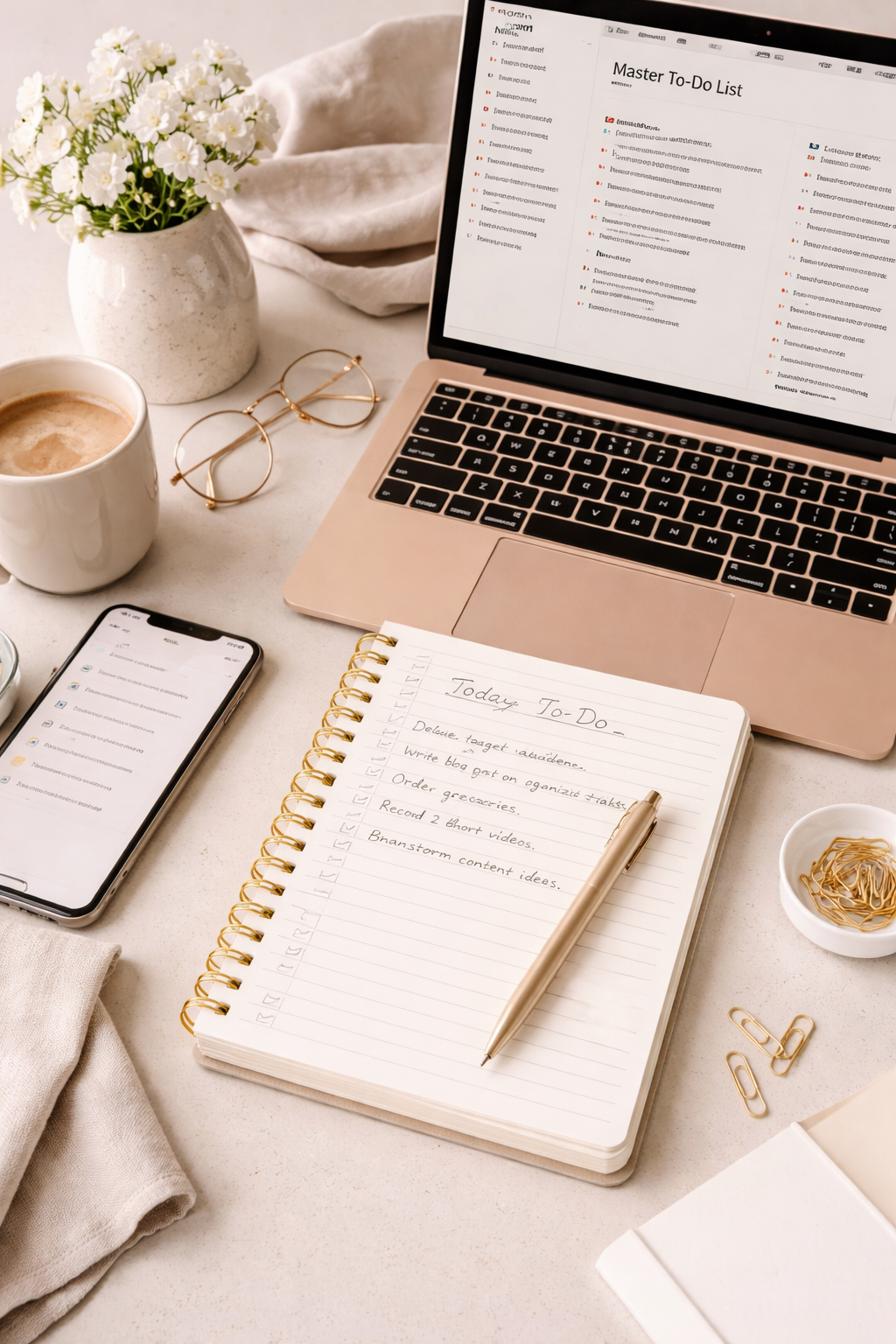
A Very Unsexy Reintroduction to the To-Do List
Hear me out.
I know you know what a to-do list is. You’ve probably made hundreds of them. You’ve probably abandoned most of them. You might even have one open right now that feels more stressful than helpful.
But I want to reintroduce the to-do list — not as a rigid productivity tool, but as a directional anchor.
Something that quietly keeps you moving forward, even when you don’t feel particularly motivated, disciplined, or perfectly planned.
For me, this comes down to two different lists, each with a very specific job.
The Long List (a.k.a. The Brain Dump That Saves Me)
The first list is my long-standing, ever-growing brain dump list.
Before anything else, let’s talk about where this list actually lives — because the system only works if it’s easy to access.
I keep my long list in two places:
Notion, where it exists as a running, lightly organized master list
My Notes app, for fast capture when I’m out, distracted, or don’t want friction
Sometimes it’s categorized. Sometimes it’s chaos. Both are fine.
The only rule is simple:
If it crosses my mind and it needs to be done at any point, it goes on the list.
This list is not a planner. It’s not a schedule. It’s a memory replacement.
As a Type B person, I naturally live in the present. I focus on what feels urgent, interesting, or immediately doable — which means the quiet, inconvenient tasks get pushed to “later” until later never comes.
Things like:
Dry cleaning
Booking appointments
Writing the blog instead of just thinking about it
The long list catches all of that.
It’s especially useful on the days where you say:
“I don’t know what to do today.”
Those are the days where you have energy but no direction — so you scroll, rot, and suddenly realize at 8pm that the dry cleaners are closed again.
When I don’t know what to do, I don’t do nothing.
I go to the list.
Example: My Long To-Do List Right now
Clean my sheets this week
Order my clean juices
Schedule dinner with Erin next week
Figure out which conferences would be best for Inexra
Create my New Year vision board
Spend time reflecting on 2025
Get my winter coat dry cleaned
Stop at the bookstore for the book club book
Get flowers at De Luca’s
Buy Jen & Haley birthday cards
Deep clean the bathroom
Brainstorm goals for 2026
Book workout classes this week
Facial? My skin is dry right now
This list exists so my brain doesn’t have to hold everything at once.
The Daily To-Do List (Where Things Actually Get Done)
The second list — and the most important one — is the daily to-do list.
This is the list that turns intention into action.
I don’t overthink the tool here either. I rotate between:
A small notebook I keep on my desk or throw in my bag
A Notion daily page when I’m working digitally
What matters is that this list is separate from the long list.
The long list holds everything. The daily list holds today.
There are no rigid rules.
Ideally, I make it in the morning — but afternoon works too
It’s not about when or how things get done
It’s simply about what matters today
I aim for five things. Some people swear by three. I like five because it gives me direction without pressure.
And yes — I include things like going to the gym. Progress is still progress.
Example: Today’s Daily To-Do List
Define my target audience for Inexra
Write a blog post on how I organize my tasks
Order groceries on Instacart (buffalo chicken wraps?)
Record 2 short-form content videos
Brainstorm content for the week
Dinner with the girls at 7pm — everything happens before then.
Why This Works for Type B Brains
My favorite part of the daily list is checking things off.
There’s something grounding about physically crossing something out — pen on paper or cursor on screen. It creates momentum in a way perfectly planned calendars never have for me.
When I’m checking things off, I know I was productive — even if my day wasn’t perfectly planned.
The key difference is this:
I don’t tell myself when or how things must be done — only that they need to be done.
That flexibility lets me move through the day without spiraling.
I can get everything done early or slowly
I can grab coffee spontaneously
I can say yes to a last-minute lunch
Nothing feels derailed because there was never a rigid schedule to derail.
If I don’t finish everything? No spiral.
Unfinished tasks don’t mean I failed — they just weren’t meant for today.
They get moved back to the long list or carried into tomorrow, and the system keeps moving.
Reflection (But Not Every Night)
I’m not someone who reflects nightly in a planner. That has never stuck for me.
Instead, I reflect in batches:
A mid-week check-in
A weekly reset
A bigger reflection at the start of a month or quarter
That’s when I zoom out and make sure my lists aren’t just busywork.
Productivity for productivity’s sake doesn’t move your life forward.
Your lists need to hold a mix of:
Daily maintenance
Life admin
And tasks that push you closer to your bigger goals
That balance is what allows me to progress without burning out.
The Quiet Proof of Progress
One of my biggest struggles is forgetting how much I’ve already done.
Once something is checked off, my brain moves on.
Having physical or digital lists I can look back on changes that. It gives me visible proof of effort — which helps on the days where it feels like I “haven’t done anything.”
Because most of the time, I have.
I may never be perfectly scheduled or hyper-disciplined — but I am consistent in my own way.
I’m not bad at discipline. I’m just better at direction.
And for me, that’s more than enough.
